Updated: May 2026
Raja Ampat vs. Komodo: Which Yacht Charter Destination is Right?
- Primary Attraction: Raja Ampat for kaleidoscopic coral reefs; Komodo for prehistoric dragons and manta rays.
- Landscape: Raja Ampat features lush, jungle-clad karst pinnacles; Komodo is defined by arid, savannah-like volcanic islands.
- Best Season: Charter in Raja Ampat from October to April; explore Komodo from April to November.
The gentle lapping of the turquoise sea against the hull of your private phinisi is the only sound. You raise your binoculars. To port, a three-meter-long dragon patrols a sun-scorched beach, its forked tongue tasting the air. To starboard, a vision of a million shimmering anthias blanketing a coral bommie in a riot of orange and purple. This is the essential question facing the discerning traveler planning an expedition through the Indonesian archipelago. It is the ultimate choice between two world-class, yet profoundly different, marine kingdoms. The decision of a Raja Ampat vs Komodo yacht charter is not about which is better, but which is distinctly, unequivocally, you.
The Underwater Realm: A Diver’s Dichotomy
For those of us who measure a journey in bar pressure and bottom time, the distinction between Raja Ampat and Komodo is stark and beautiful. As a travel editor, I’ve spoken with countless dive masters and marine biologists, and the consensus is clear: these are two different underwater universes. Raja Ampat, located in the heart of the Coral Triangle, is what Dr. Gerald R. Allen famously called the “species factory.” The numbers are staggering: over 1,628 species of reef fish and more than 600 species of hard coral—that’s 75% of the world’s known coral species. A single dive at a site like Cape Kri can reveal more than 370 species. The diving here is an immersion in sheer biomass and color. Expect vast, sloping reefs carpeted in soft corals of every imaginable hue, enormous schools of fish, and gentle drift dives. It is, for many, the pinnacle of coral reef diving. Our sources on the ground report water temperatures consistently hovering between 28-30°C, making it a comfortable, multi-dive-a-day environment.
Komodo, by contrast, offers a wilder, more adrenaline-fueled experience. The nutrient-rich waters flowing between the Indian and Pacific Oceans create powerful currents, which in turn attract magnificent megafauna. This is the place for encounters with aggregations of giant manta rays at cleaning stations like Manta Point. Dive sites such as Castle Rock and Batu Bolong are legendary for their high-voltage action: sharks, giant trevallies, and tuna patrol the reef edges. While it has beautiful coral gardens, Komodo’s strength lies in its thrilling topography of pinnacles and channels and its reputation for both world-class macro life—think pygmy seahorses and flamboyant cuttlefish—and its pelagic show. The water can be slightly cooler, sometimes dropping to 25°C in the south, demanding a slightly thicker wetsuit. The choice is one of philosophy: do you want to lose yourself in the planet’s most diverse aquarium, or do you want to ride the currents with giants?
Topside Terrains: Volcanic Savannah vs. Karst Archipelagos
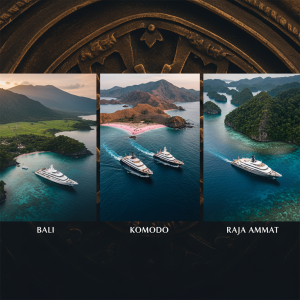
Above the waterline, the visual narrative of each destination diverges completely. Komodo National Park, a UNESCO World Heritage site since 1991, is a landscape forged by fire. The islands are volcanic, rugged, and defined by a stark, dramatic beauty. During the dry season (April-November), the rolling hills are covered in golden grasses, resembling the savannahs of Africa more than a tropical paradise. The signature experience is the short but steep trek to the viewpoint on Padar Island, where you are rewarded with a panorama of tri-colored beaches—white, black, and pink—curving into azure bays. This arid grandeur extends across the 1,733-square-kilometer park, offering challenging hikes and a sense of raw, untamed nature. It’s a photographer’s dream, a land of high contrast and epic vistas where the sun beats down with an intensity that feels prehistoric.
Raja Ampat, meaning ‘The Four Kings,’ presents an entirely different aesthetic. It is an immense archipelago of over 1,500 jungle-clad islands, primarily composed of limestone karst. These islands have been eroded over millennia into fantastical shapes—sharp pinnacles, hidden lagoons, and undercut mushroom-like islets. The iconic view is from Piaynemo or the more demanding Wayag, looking out over a seascape dotted with these verdant, emerald formations. The experience here is one of exploration and discovery. Your yacht’s tender can navigate through hidden passages, revealing saltwater lakes and secret coves. The air is humid, the vegetation is dense, and the feeling is one of being in a lost world. Unlike Komodo’s exposed trekking, topside activities in Raja Ampat often involve kayaking through serene mangrove forests, birdwatching, or visiting small, traditional villages. The landscape is softer, wetter, and more mysterious.
Iconic Wildlife: Dragons and Birds of Paradise
The marquee wildlife encounter in Komodo is, without question, the Komodo dragon (Varanus komodoensis). These are the largest lizards on Earth, growing up to 3 meters in length and weighing over 70 kilograms. To see them in their native habitat, patrolling the shores of Komodo or Rinca islands, is a truly primeval experience. Guided by a park ranger—a mandatory and essential safety measure—you walk trails where these apex predators are a common sight. The encounter is visceral; their lumbering gait, powerful tails, and unblinking stare connect you directly to a bygone era. While the dragons are the main draw, the park is also home to Timor deer, wild boar, water buffalo, and a rich variety of birdlife. But let’s be clear: people charter a yacht to Komodo for the dragons, and the experience never fails to deliver a profound sense of awe.
Raja Ampat’s celebrity creature is more elusive and altogether more delicate: the bird of paradise. The islands of Waigeo and Batanta are home to the spectacular Red Bird of Paradise and the enigmatic Wilson’s Bird of Paradise. Spotting them requires a pre-dawn trek into the dense rainforest, led by a local guide who knows the specific display trees, or “leks.” The reward for your early start is witnessing one of nature’s most elaborate courtship dances, a flash of iridescent color and sound deep in the jungle. It’s a patient, quiet pursuit, the antithesis of a dragon encounter. Beyond the birds, Raja Ampat’s other headline acts are found in the water. It is one of the few places on earth where both reef manta rays and the larger, oceanic manta rays can be seen. There are also opportunities for swimming with whale sharks in Cenderawasih Bay, a potential extension to a standard Raja Ampat itinerary. The choice here is between terrestrial beast and avian beauty.
Seasonality and Sailing: Navigating the Indonesian Calendar
Timing is everything when planning an indonesia yacht rental, and the seasons for Raja Ampat and Komodo are almost perfectly opposite. This is a critical factor in the Raja Ampat vs Komodo yacht charter decision. Komodo’s prime season falls during the dry southeast monsoon, typically from April through November. During these months, the skies are clear, the seas are generally calm, and the hills take on their iconic golden hue. This is the ideal time for both diving and trekking. The shoulder months of April, May, and October often provide the best balance of great weather, fewer crowds, and lush green landscapes before the peak dry season sets in. From December to March, the northwest monsoon can bring rain and rougher seas, making some dive sites inaccessible.
Raja Ampat follows the opposite pattern. Its best season is from October to April, during the northwest monsoon, which ironically brings calmer seas and drier weather to this specific region of West Papua. This is the peak period for diving, with exceptional visibility and placid surface conditions perfect for cruising between the islands. From May to September, the southeast monsoon that blesses Komodo can bring wind and surface chop to Raja Ampat, reducing visibility and making some crossings less comfortable. Understanding this meteorological duality is paramount, and it’s a topic we cover in depth when discussing the best time for Indonesia Yacht Rental Atelier. Your choice of destination may simply come down to when you have the time to travel.
Logistics, Access, and The Charter Itself
The practicalities of reaching these remote paradises play a significant role in your planning. Komodo is decidedly the more accessible of the two. The gateway is Labuan Bajo (LBJ) on the island of Flores, which is serviced by multiple 75-minute flights per day from Bali (DPS), a major international hub. Upon arrival in Labuan Bajo, the harbor where your yacht awaits is a mere 10-minute drive away. This ease of access makes Komodo an excellent option for trips of 7 to 10 days, or as a seamless extension of a Bali vacation. The charter itineraries here are well-established, typically covering the central, north, and southern regions of the park, each offering a different flavor of diving and landscapes.
Raja Ampat, befitting its “last paradise” status, requires a more concerted travel effort. The main port of entry is Sorong (SOQ) in West Papua. Reaching Sorong usually involves an overnight flight from Jakarta (CGK) or a connection through cities like Makassar (UPG). The total travel time from a major hub like Singapore or Hong Kong can easily exceed 12-15 hours. Because of this, we advise clients that a Raja Ampat charter should be a minimum of 10 to 12 days to make the journey worthwhile. The ability to customize your Indonesia yacht rental is paramount here, as itineraries can focus on the northern highlights of Wayag, the central biodiversity hotspots around the Dampier Strait, or the southern majesty of Misool. A well-prepared traveler is a relaxed one, which is why consulting a detailed Indonesia Yacht Rental Atelier packing guide is essential for the more expeditionary nature of a Raja Ampat journey.
Quick FAQ: Raja Ampat vs Komodo
Is Raja Ampat or Komodo better for non-divers?
While both offer incredible experiences, Komodo generally has more to offer the non-diver. The combination of iconic wildlife trekking to see the dragons, scenic hikes like the one on Padar Island, and snorkeling at world-class sites like Pink Beach provides a more varied itinerary for those not spending their time underwater.
What is the typical cost difference for a charter in these regions?
The charter rates for the yachts themselves are comparable. The primary cost difference comes from logistics. Flights to Sorong (Raja Ampat) are typically more expensive than flights to Labuan Bajo (Komodo). Furthermore, park and port fees in Raja Ampat can be significantly higher, sometimes adding up to $150-$200 USD per person per day, compared to Komodo’s more modest fees. This is a key detail to review during the Indonesia Yacht Rental Atelier booking process.
Can I visit both Raja Ampat and Komodo on a single yacht charter?
Technically, yes, but it is an enormous undertaking. These are “crossing” or “repositioning” voyages that cover over 1,000 nautical miles and require at least three to four weeks. They are offered only a couple of times a year as yachts move between the two destinations to follow the seasons. For most travelers, it is far more practical to consider them as two separate, magnificent trips.
Ultimately, the chart of your Indonesian adventure is for you to draw. Will it be the raw, volcanic drama and primeval encounters of Komodo, a world of savannahs and dragons? Or will it be the serene, labyrinthine beauty of Raja Ampat, an immersion into the planet’s most vibrant aquatic heart? Each promises a journey of profound discovery. When you are ready to weigh anchor and transform these visions into reality, the experts at Indonesia Yacht Rental Atelier are prepared to craft your perfect private charter, ensuring your voyage is as flawless as the destinations themselves.