Updated: May 2026
Indonesia Yacht Rental vs Charter — The Real Difference, Explained
Indonesia Yacht Rental is a curated Indonesia luxury tourism experience offered by Indonesia Yacht Rental Atelier: handpicked routes, vetted operators, transparent pricing, and 24/7 concierge support across Indonesia.
- What makes Indonesia Yacht Rental a premium experience.
- How Indonesia Yacht Rental Atelier curates exclusive access and concierge logistics.
- Routes, seasons, and pricing transparency — no hidden fees.
Yacht Rental vs Yacht Charter
The real difference, explained for Indonesian waters
In Indonesia the words “yacht rental” and “yacht charter” appear interchangeably across operator websites, brokerage marketing and customer inquiries. The casual use is fine for everyday conversation, but for a charterer making a six-figure booking the technical difference is worth understanding. The two models cover different products in different parts of the global yacht market, and although in Indonesian waters the practical answer is almost always the same fully-crewed product regardless of how it is described, knowing where the line sits helps clarify what you are actually buying.
The strict definition of yacht rental
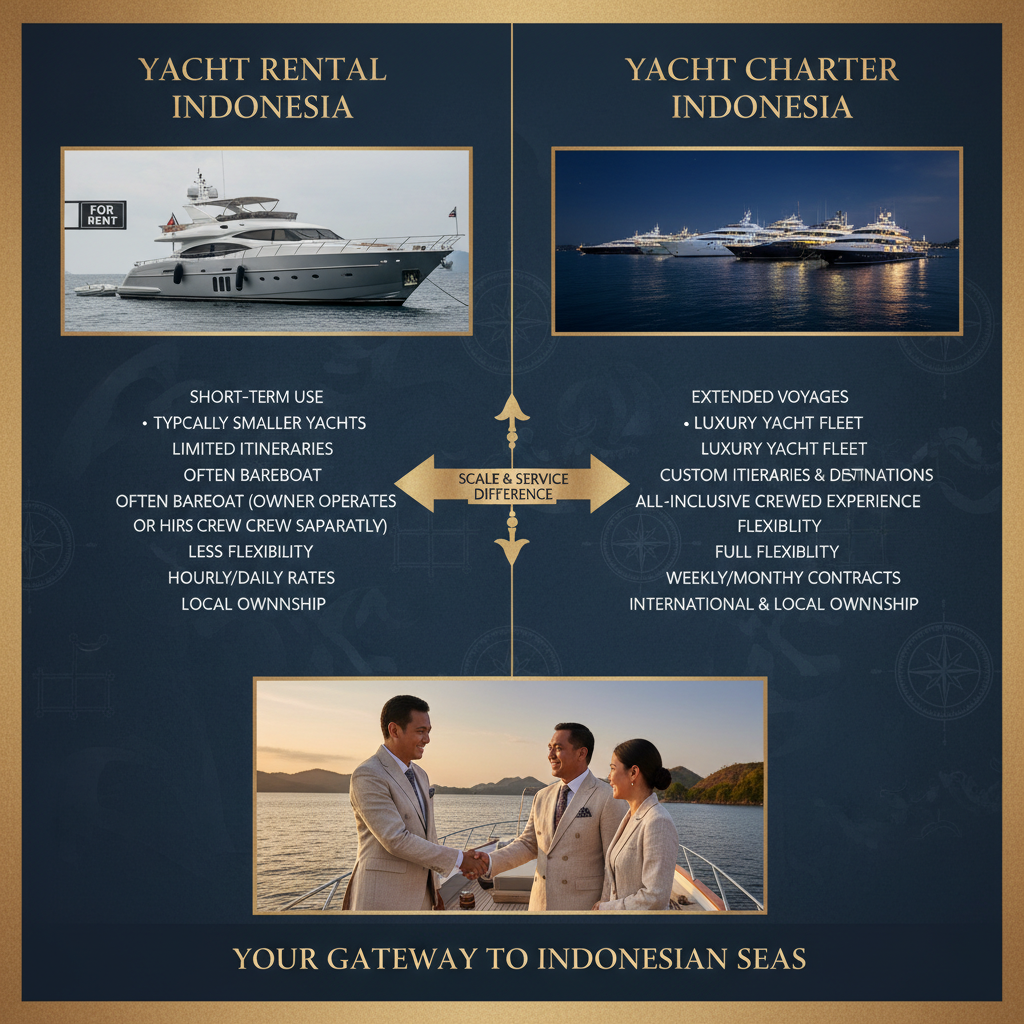
In strict yacht-industry terminology a yacht rental is the whole-vessel hire of a boat without crew or provisions. The renter takes possession of the vessel, supplies their own captain (or skippers themselves with a recognised qualification), provisions food and fuel from their own budget, plans the itinerary independently, and returns the vessel at the agreed date. This is the bareboat model — common in the Caribbean and Mediterranean for catamarans and small motor yachts up to 50 feet, where the renter holds an internationally recognised yachting qualification (RYA Day Skipper or higher in most jurisdictions, US Sailing or ASA in American waters). Bareboat rental is significantly cheaper than crewed charter because the operator is renting only the asset, not the asset plus the labour.
The strict definition of yacht charter
A yacht charter in strict terminology is the rental plus full crew and provisions. The captain, crew, chef, dive master, fuel, food and beverages, watersports equipment and itinerary planning are all included in the published all-in rate. The charterer steps onto the vessel and the operator delivers the full guest experience — meals, transfers, dives, shore excursions, daily housekeeping, beverage service. This is the crewed-charter model — dominant for vessels of 50 feet and above, universal for vessels of 80 feet and above given the operational complexity. Crewed charter is the higher-priced product but covers a categorically different deliverable: the asset, the labour, the food, the fuel, the experience and the safety umbrella.
Why the two terms blur in Indonesian usage
Indonesian yacht industry usage blurs the two terms because the bareboat product effectively does not exist for premium vessels in Indonesian waters. Three reasons. First, Indonesian maritime regulation requires licensed crew on commercial passenger vessels above defined size thresholds, which captures every vessel above approximately 30 feet that holds a passenger licence. Second, the operational complexity of cruising in Indonesian waters — strong currents in Komodo, navigating Raja Ampat’s coral atolls, managing the Banda Sea’s unpredictable weather windows, anchoring in deep-water bays without harbour infrastructure — exceeds what most amateur skippers can safely handle. Third, the cultural register and language gap between non-Indonesian charterers and the local maritime context make crewed charter the only practical model for most international guests. The result is that the word “rental” gets used in casual conversation but the actual product delivered is the crewed-charter model with captain, crew, chef and full inclusions.
Where bareboat does exist in Indonesia
A small bareboat market does exist in Indonesia, concentrated in two product categories. First, sailing catamarans in the 38-50 foot range based out of Bali, Bintan or Lombok, where qualified skippers (RYA Day Skipper or equivalent) can rent the vessel for short coastal trips. Indicative bareboat rate USD 1,200 to 2,800 per day excluding food, fuel and any day-skipper hire. Second, sport-day-charter rentals where the captain is hired separately from a different vendor — a renter takes the boat through one operator and the captain through another, common for short Bali day-trips. In all other premium categories — phinisi, mid-size motor yacht, superyacht — the only available model is the crewed charter regardless of which word the operator uses in its marketing.
What this means for a charterer making a booking
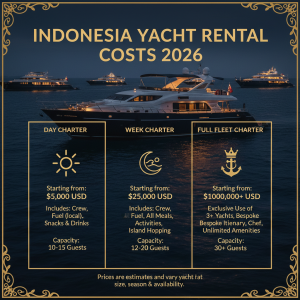
For a charterer the practical implication is straightforward. When you receive a quote from an Indonesian operator described as a “yacht rental,” verify whether the rate is bareboat or fully-crewed by checking what is included. A genuine all-in rental rate (USD 25,000 per week and above for premium vessels) is invariably crewed and includes captain, crew, chef, all meals, fuel, dive equipment, and tender operations. A noticeably lower rate (under USD 15,000 per week for a 38-metre phinisi) is suspect — either the rate excludes crew, food and fuel and you will pay these separately, or the vessel is below the premium standard advertised. Our atelier publishes all rates as transparent all-in fully-crewed charter prices regardless of whether the inquiry uses the rental or charter terminology.
A note on Indonesian maritime law
Indonesian commercial passenger maritime regulation under the Ministry of Transportation requires licensed captains and crew on commercial pleasure vessels above defined thresholds, with certification by national bodies and STCW credentials for the master. The regulatory framework reinforces the crewed-charter model as the operational default. Insurance coverage for premium vessels (hull, P&I, passenger liability) is also typically conditional on licensed crew operation, meaning bareboat self-skippered models would not be covered under standard policies. Our atelier confirms full insurance and licensing on every partner vessel before the booking is finalised — this is part of the diligence work the charter desk does invisibly between inquiry and contract.
The bottom line for prospective charterers
Stop worrying about whether the product is called a rental or a charter. Both words describe the same fully-crewed private booking in 95 percent of Indonesian use cases above 50-foot vessels. Focus instead on what is actually included in the all-in rate, who the captain and crew are, which region the vessel is licensed for, and whether the operator carries Indonesian PT licensing with full insurance coverage. Our private fleet brief walks through these inclusions vessel by vessel, and our charter desk will issue a transparent all-in quote within twenty-four hours of any inquiry.
Authority context: Komodo National Park (UNESCO World Heritage 1991), Pinisi Shipbuilding (UNESCO Intangible Heritage 2017), PADI Divemaster certification.